The Quest for the Perfect Tomato
I've been actively gardening in Saint-Didace for forty-five years. In 1980, Diane and I established our first garden, transplanting about ten tomato plants and growing this nightshade, the most popular vegetable plant in the West, ever since.  Since then, I have been continuously experimenting with tomato cultivation and researching the cultivars that are best suited to the organic farming we practice: those that are most resistant to disease and physiological disorders, those that are early, productive, and above all, those that produce tasty fruit. In my quest for the perfect tomato, in 1985 I met Brother Armand Savignac, a Saint-Viateur cleric residing at the Christian Reflection Center in Joliette. Condemned at the age of 42 by official medicine due to chronic constipation problems, he left teaching to devote himself full-time to gardening in order to feed his community. Following advice from naturopaths he consulted, he adopted a primarily fruit-based diet, which allowed him to live to the age of 95. While in 1948, he was learning the Indore composting method with Alphonse Dufresne of Saint-Félix-de-Valois, he met Raymond, Alphonse's brother, who gave him some pink tomato seeds that Brother Armand would sow the following year. He was so impressed by the vigor of the plants produced as well as the succulence of the harvested fruits that he abandoned all the cultivars he had experimented with until then to devote himself exclusively to growing this tomato, which he named Dufresne in honor of the man who had given him the seeds.
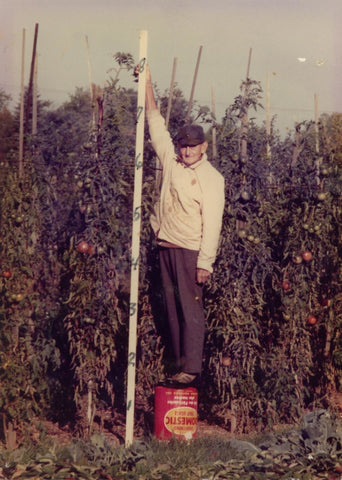
When I met Brother Savignac in his garden in 1985 when he was almost 90 years old, I was amazed by the quality of his 200 tomato plants, which reached 3 meters in height, as well as by the numerous fruits they bore. I brought some seeds home and have been growing this tomato ever since. I named it the Savignac in honor of Brother Armand, who saved it from extinction while improving it through patient and meticulous selection. Through selection, I in turn improved this cultivar to adapt it to a colder region than the Joliette plain and to make it more resistant to diseases, including early blight, a common disease of the species. For more than 25 years, I have been producing the seeds. That is our pink tomato.

On the other hand, my quest for a red tomato lasted more than thirty years. I must have experimented with no fewer than 100 cultivars, none of which truly satisfied me. While the taste gave me complete satisfaction, the fruit cracked or was too susceptible to early blight. While the plant was vigorous and productive, the flavor of the fruit was dull. My quest ended, however, last year when I experimented with the Mother tomato , the seeds of which were given to me by David Neufeld, a Manitoba Menonite whom I met in Montreal while he was here for a conference on food security.
 I first tried it in 2011 and enjoyed its flavor, early maturity, and disease resistance. I saved seeds from the fruit produced and grew 12 plants this year for seed production. To learn the history of this cultivar, which in some ways concludes my quest for a satisfying red tomato, I wrote to David, who summarized what he knows about its origins. In his village of Boissevain, Manitoba, two Mennonite sisters, Mary and Agnes Dyck, lived together. The two women, who worked as nurses in the small village hospital, cultivated a huge garden in their yard. Mary Dyck died a few years ago, and Agnes, now at the ripe old age of 90, had to leave her home. Before abandoning her garden, she entrusted David with some seeds of this tomato so that he could propagate it and offer some to anyone who might want to grow it. She then told him that she had received the seeds of this tomato from her mother who had obtained them, upon her arrival in Winnipeg, from a Ukrainian emigrant. Since the seeds came from her mother, she always called him Mother. History does not say if the Ukrainian in question was Mennonite, but it is worth remembering that this community lived in Ukraine for 150 years before being expelled by Stalin in 1920, which explains their strong presence in Western Canada where a good number emigrated. Thus, this heady red tomato named Mother, originally from the Andes like all the others, reached Europe with the Spanish, passed through Ukraine from where it migrated to Manitoba around 1920 before ending up at the Jardins du Grand-Portage in 2011 where we have been growing it ever since.

The Savignac tomato and the Mother tomato are available at: www.semencesduportage.com
Yves Gagnon , author and seed producer.