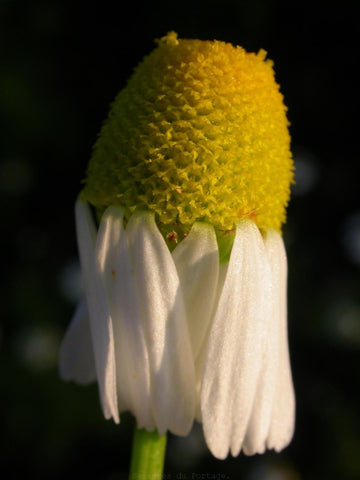
German chamomile, a small flower with a thousand virtues
It's difficult to determine the exact origin of what is called German chamomile — Matricaria recutita — since the asteraceae has naturalized almost everywhere it is cultivated, whether in North America, South America, temperate regions of Asia, Europe, and North Africa. We know it was already widely used in antiquity. The Egyptians revered it and dedicated it to the Sun God. In Arabia, it was made into massage oil. The Greek physician, pharmacologist, and botanist Dioscorides, author of De Materia Medica, used it as an emmenagogue plant. Sometimes called wild chamomile, small chamomile, or matricaria chamomile, it is, however, the designation German chamomile that is most commonly used in America, undoubtedly because Germans always carried it during their migration to the continent, aware of its innumerable virtues.
Multiple Properties
German chamomile flowers have antispasmodic, anti-inflammatory, antiseptic, vulnerary, carminative, stomachic, tonic, digestive, antibacterial, antiviral, anti-ulcer, diuretic, antihistamine, antifungal, analgesic, diaphoretic, febrifuge, emmenagogue, estrogenic, antioxidant, soothing, and slightly sedative properties. In hot infusion, chamomile promotes sleep, soothes coughs, and treats flus, colds, bronchitis, asthma, and allergic rhinitis. Simply infuse about ten flowers for 10 minutes in 2 cups of boiling water and, most importantly, don't forget to cover it so that the essential oils do not escape. In a steam bath, these oils are beneficial for the mucous membranes of the nose and bronchi. For children, a weaker infusion made from 3 flowers infused for 5 minutes in 1 cup of water should be given 3 times a day.
The infusion is also beneficial for newborn colic: give 5 ml (1 tsp) of infusion every 15 minutes, while the mother can have up to 4 cups a day. As an antifungal, it can also be brushed on the tongues of infants suffering from thrush, as well as on the mother's breasts. In gardening, seedling blight is treated with a decoction of chamomile flowers. Chamomile infusion calms stressed, anxious, nervous people and those suffering from sleep disorders. For digestive problems, it is suggested to drink a warm, more concentrated infusion (10 ml or 2 tsp of flowers per cup) steeped for a longer time, which increases bitterness and anti-inflammatory effects. The drink then acts on the mucous membranes of the digestive system, but also on all mucous membranes of the body. It restores digestive secretions, normalizes digestive system movements, and treats stomach ulcers. It is also recommended for irritable bowel, gastrointestinal spasms, ulcerative colitis, gastric reflux, diarrhea, and irritable bowel syndrome. Very rich in calcium, which it helps assimilate, the infused plant prevents osteoporosis. Consumed daily, at a rate of 3 cups per day for several weeks, chamomile infusion will relieve painful menstruation, associated irritability, as well as digestive problems linked to premenstrual syndrome.
Applied as a rinse, chamomile infusion shines and lightens hair while improving scalp health. I use it to clean and treat my old cat's inflamed and watery eyes. Topically, it reduces inflammation of mucous membranes. In the case of hemorrhoids, a concentrated infusion as a poultice is indicated, as are sitz baths or steam baths. The treatment is completed by applying an herbal cream based on comfrey and chamomile. Fresh chamomile flowers macerated in a gentle oil for 15 days produce a magnificent massage oil that is applied for relaxation, to reduce joint, rheumatic, and arthritic pain, and to treat skin problems. The oil is also used to treat vaginitis.
Easy Cultivation
Chamomile grows in full sun in light, sandy soil, poor in organic matter, and well-drained. Appreciating cool temperatures, it is sown early in autumn or early in spring; it can also be propagated by indoor sowing in April. The seeds are tiny, they barely need to be covered. They will germinate in a week. Chamomile reseeds easily. Once established, it returns every spring. Young plants are transplanted 25 cm apart. They will reach 20 to 50 cm in height. Chamomile is an herbaceous, annual plant with an upright stem. Its delicate alternate leaves are divided into linear segments. A member of the Asteraceae family, it has numerous yellow tubular flowers in the center of each of its flower heads and, along the edge, a few flowers sheathed in a white ligule called a petal.

Photo: Danièle Laberge
The flowers are harvested when they are fully open and their ligules begin to bend downwards. It is important to pick them after two days of good weather, at noon. For winter infusions, they must be dried very thoroughly. They contain 80% water and numerous volatile essential oils. It is best to use a dehydrator at 35 °C and ensure that the flowers are dry to the center of the inflorescence. They can also be dried on racks in the open air, away from light and drafts. However, ambient conditions must be favorable. Quality flowers are recognized by their honey-like scent. Anny Schneider, in her book "Je me soigne avec les plantes sauvages," offers a recipe for preparing a sun-infused oil from dried chamomile flowers.
Sun-infused Oil
Ingredients
- 250 ml (1 cup) organic virgin olive oil
- 30 g (1 oz) dried chamomile flowers
- 30 drops lavender essential oil
Preparation
Place the flowers and oil in an airtight jar. Macerate for one month, shaking regularly. Filter carefully, add the lavender. This soothing oil keeps for 6 months. Use for minor skin irritations, neuralgic and muscular pain, dry skin, and even to reduce wrinkles.
Many thanks to Danièle Laberge for her magnificent photos.
Schneider, Anny. Je me soigne avec les plantes sauvages, Éditions de l'homme, 2011
Bernard, Diane. La santé au rythme des saisons. Biovi, 2005.
Gagnon, Caroline, Lanctôt-Bédard Valérie. Materia medica pour sorcières et sorciers avertis… 2002-2003
Provost, Marie, Jutras, Marie. Compendium. Clef des Champs.
O'Reilly, Moïra. Interaction, contre-indications et complémentarités, plantes-médicaments. L'Herbothèque, 2004.