About Tavor artichoke
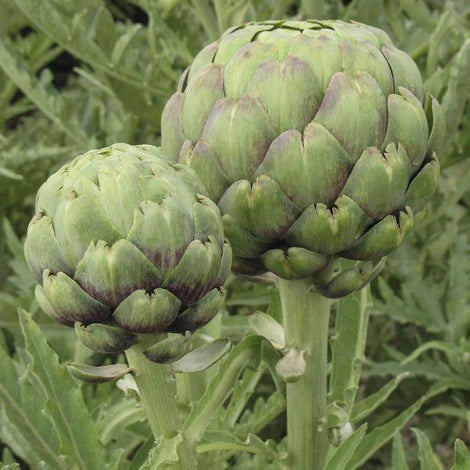
The Tavor artichoke is an early, low-thorn variety with a very good, sweet, and tender taste. After the first bud has formed, smaller artichokes develop on axillary stems. A magnificent plant for edible landscaping. To obtain artichokes in the same year as sowing, expose the seedlings to frost to shock them.
Here is an explanation taken from the book The Ecological Culture of Vegetable Plants by Yves Gagnon :
Vernalization, exposure of seedlings to frost.
"The seeds are sown in a tray in germination soil at a rate of 1 seed every 5 cm, covered with 2 cm of soil. Once the first true leaves have unfolded, the seedlings are transplanted into growth soil or into 10 to 12 cm diameter pots. To force flowering, the young plants are exposed to frost. This is a form of abrupt acclimatization that acts as stratification. The plants are frost-resistant, but absorb the stress that will induce early flowering. The plants are transplanted into the garden 2 to 3 weeks before the last frost."
Check out the FAQ for more information about your crops.
Growing tips for Tavor artichoke
Gardening articles related to Tavor artichoke
Our tavor artichoke seeds are certified organic.
We use natural, eco-friendly methods to grow our plants, without pesticides, herbicides, or chemical fertilizers. By choosing our organic tavor artichoke seeds, you support a responsible, nature-friendly approach.
Learn more:
To succeed with your artichoke plants
As modern artichokes are not programmed to produce flower buds in their first year, to force flowering, young plants must be exposed to a few light frosts. This is a form of acclimatization that acts as stratification. The plants resist frost, but register the stress which will induce early flowering. The plants are transplanted into the garden 2 to 3 weeks before the last frost.
Yves Gagnon
Artichoke growing conditions
In temperate climates, such as the Mediterranean or Brittany, artichokes are grown as perennials. They produce for two or three years after the year of planting. In more northern regions, where winters are harsh, they are grown as annuals; they should then be sown indoors at the beginning of March.
Artichokes thrive in warm, humid conditions and require full sunlight. They prefer deep, well-loosened soils rich in organic matter. Artichokes require abundant fertilization with young compost at a rate of 1 to 1.5 t/100 m2. The soil should remain moist, but not excessively so. The optimal pH for growing them is between 6 and 7.
Crop rotation
Grown as an annual, the artichoke comes first in the rotation, ideally after a green manure. Grown as a perennial, it should be given a separate place in the garden.
Artichoke Companionship
Since artichokes require a lot of space, in the spring, when the plants are young, you can grow various leafy vegetables between their rows. To prevent aphids, you can plant them with nasturtiums. Marigolds are also a good companion. Finally, white clover can be planted between the plants as an intercrop.
— These valuable tips were written by Yves Gagnon, in the book The ecological cultivation of vegetable plants , Colloidal Editions.