From Montreal melon to Oka melon
A heritage adventure
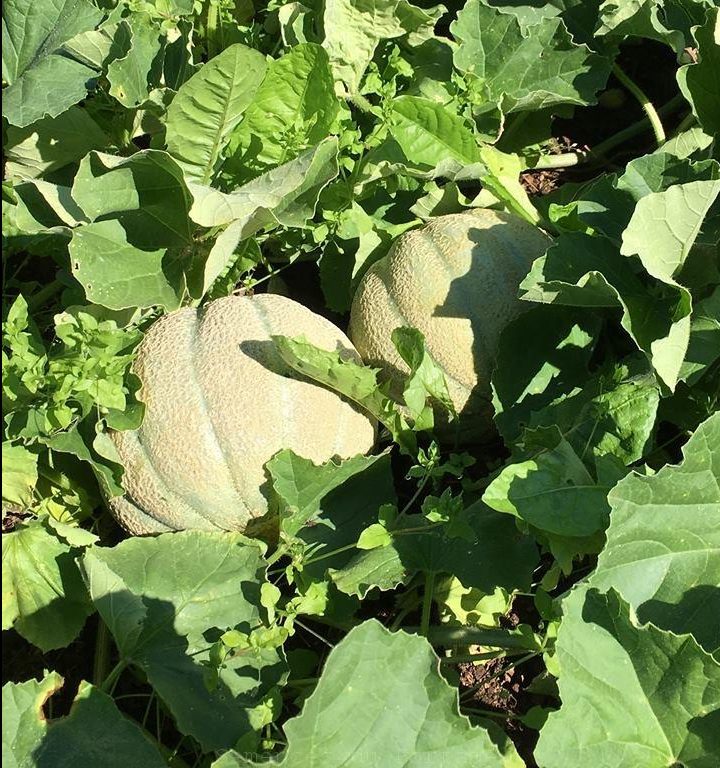
It's now 25 years since I became a seed grower and I've noticed an inexhaustible interest in the Montreal melon , an important fruit crop at the beginning of the last century on the southern slope of Mount Royal, today the Côte-des-Neiges — Notre-Dame-de-Grâce borough. The protuberant green, musky-fleshed melon was then sold in slices for up to 1.50 each in the cities of New York and Boston. We know that already in Quebec in 1684, the Jesuits were producing a large melon with a nutmeg flavor, undoubtedly the ancestor of the Montreal melon .
Literature also informs us that in the 1800s, the Décarie and Groman families cultivated this strain, which they selected and improved on their Montreal farms. Its production required forcing techniques based on hot beds with double frames. Around 1905, it is reported that the Décarie family produced fruit that could weigh up to 12 kg and that sold for up to $15 per dozen on the American market, a fortune at the time.
Starting in 1920, with urban sprawl, the farms that produced it were sold to real estate developers, and little by little, the cultivation of the legendary melon was reduced and then completely abandoned. Fortunately, in 1996, Gazette journalist Mark Abley, curious about heritage, found some seeds in a U.S. Department of Agriculture seed bank in Iowa. Ken Taylor, owner of a farm on Île-Perrot, was given the task of sowing them. Only one seed out of the 200 recovered germinated, but the resulting plant helped save the Montreal melon from extinction. Some years, seeds can be found at artisanal seed companies.
Creation of the Oka melon
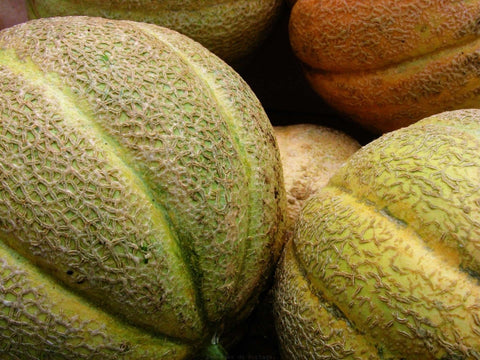
Because the Montreal melon was large, did not withstand transport well, was complex to grow, and was fond of heat and weather, it was difficult to grow successfully anywhere other than the island of Montreal. This is partly why Father Athanase, a Cistercian monk and director of the Oka Agricultural Institute, crossed it around 1910 with the American Banana melon. The result was a highly aromatic, fleshy, but less corpulent muskmelon than the Montreal melon and, above all, less dependent on degree days to ripen its fruit. Through laborious selection of the descendants of this hybrid, it was possible to stabilize its genetics and create an open-pollinated cultivar that could transmit its characteristics to its descendants. This is how the Oka melon was born. However, when the Institute closed in 1962, the cultivar was almost lost. Fortunately, some seeds were found at a gardener's in L'Île-Bizard, which allowed us to save it in extremis. It has since been successfully established in several regions of Quebec. I have been growing it for 25 years in Saint-Didace in zone 4b and have managed to produce seeds.
Cultivation techniques
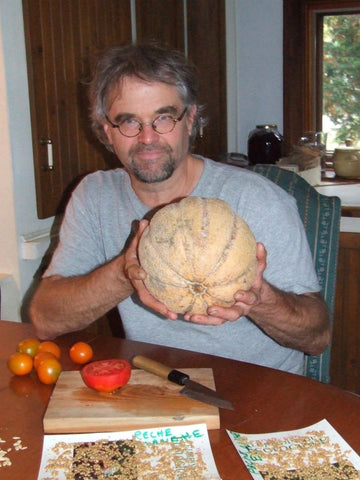
At the beginning of May, I sow 2 seeds per 8 cm diameter plastic pot in a potting mix made up of 4 parts mature compost, 3 parts perlite and 3 parts coconut fiber. When both seeds germinate, at the 3-leaf stage, I prune the less attractive of the two plants with scissors. After a month of attentive care, I transplant the plants at the beginning of June at 1.5 m intervals in light soil, generously amended with compost and well exposed to the sun. The secret is not to disturb the roots when transplanting. The root ball must be kept intact during the operation. This involves moistening the potting mix well, compressing the root ball with your fingers and supporting it well when placing it in the planting pit. It is also important to choose a location facing south and sheltered from the wind.
Using agrotextile during the first month of growth protects young plants from cool night temperatures as well as the striped cucumber beetle, the main pest of cucurbits. Although many gardeners prune plants during the summer, I only prune the tips of the stems in August to remove fruit that is unable to ripen. Generally, 4 to 6 fruits of 2 to 3 kg per plant are harvested in August. Its flesh is thirst-quenching, delightful, and fragrant. Fragrant and sweet, it freezes very well, allowing you to prepare creamy sorbets and seductive granitas in winter.

Yves Gagnon, author and seed producer.