


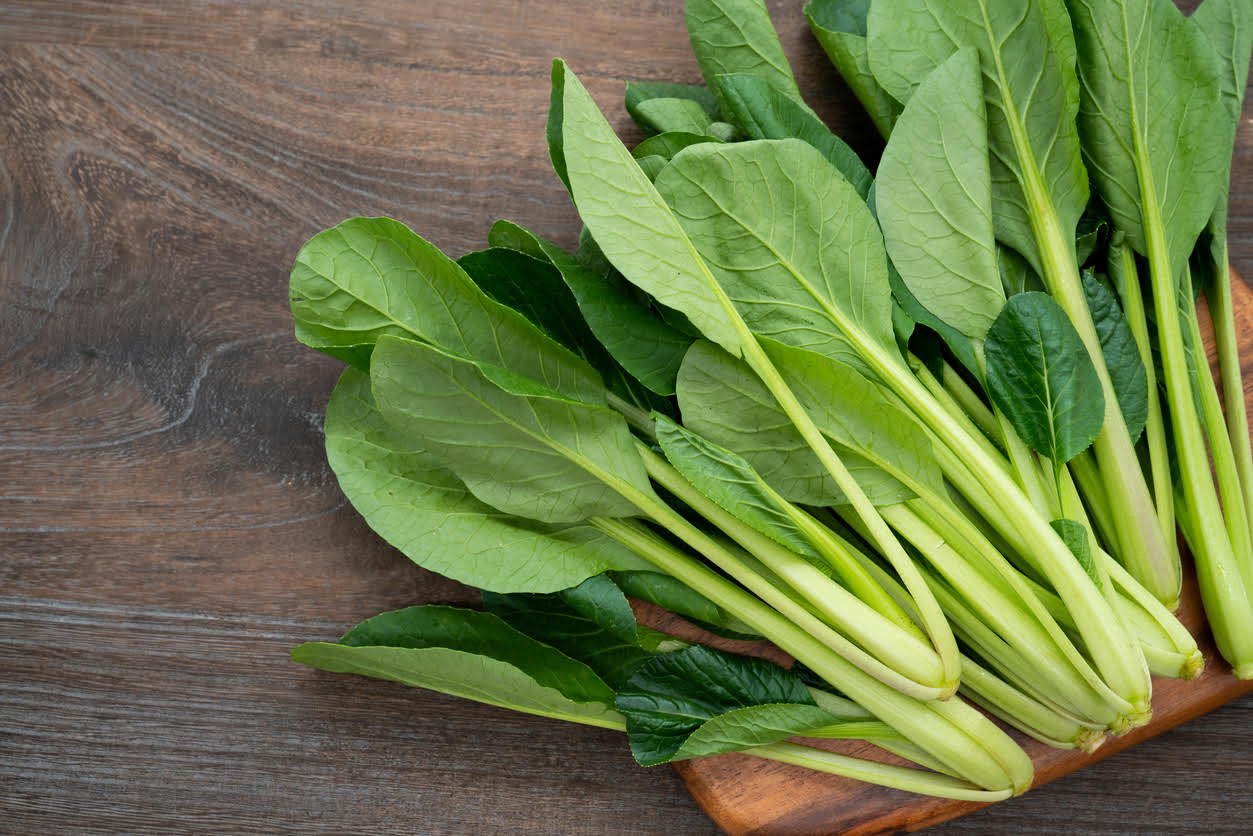
About Komatsuna spinach-mustard
An Asian leafy vegetable, Komatsuna, also known as Mustard Spinach, is interesting for its rapid growth and fresh, mild flavor. Young leaves can be eaten stir-fried or in salads. Recommended for urban agriculture.
Growing tips for Komatsuna spinach-mustard
Frequently Asked Questions
Find answers to common questions about this product
Que peut-on semer en août au Québec ?
Jusqu'à quand peut-on semer à l'automne ?
Qu'est-ce qu'un semis en dormance ?
Quels légumes poussent le mieux en pot sur un balcon ?
Quelle taille de pot faut-il selon le légume ?
Combien d'heures de soleil faut-il sur un balcon ?
Est-ce la moutarde qu'on sème comme engrais vert ?
Pourquoi ma moutarde monte-t-elle en graine si vite ?
Peut-on manger les fleurs de moutarde ?
Que signifie une semence biologique certifiée ?
Faut-il des semences bio pour faire un jardin bio ?
Quelle différence entre biologique et Culture Nature ?
Qu'est-ce que le semis direct ?
Quand le sol est-il assez réchauffé pour semer ?
Pourquoi mes graines semées au jardin ne lèvent pas ?
Do you have another question?
Our komatsuna spinach-mustard seeds are certified organic.
We use natural, eco-friendly methods to grow our plants, without pesticides, herbicides, or chemical fertilizers. By choosing our organic komatsuna spinach-mustard seeds, you support a responsible, nature-friendly approach.
Learn more:
Yves Gagnon
Growing conditions for Chinese cabbage
Chinese cabbages are fast-growing plants that are very sensitive to environmental conditions. Early frost, an increasing photoperiod, transplanting, heat, and drought induce premature bolting, which compromises quality and yield. Therefore, Chinese cabbage is propagated by direct seeding and is preferably produced for an autumn harvest. Since the species prefers a decreasing photoperiod, cool weather, and tolerates temperatures as low as -8 °C, the best quality is achieved under autumn conditions. Chinese cabbages require full sunlight. They are best grown in cool, moist, well-drained, humus-rich soils. A well-structured clay soil is ideal for their cultivation, but a light soil, well-amended and irrigated as needed, produces good yields. Chinese cabbages
are demanding in mature compost. The soil for their cultivation must be amended with 1 t of mature compost per 100 m2. They are, like other brassicas, demanding in boron. Chinese cabbages react poorly to drought. In dry periods, they must therefore be irrigated. Applying mulch helps to maintain a constant humidity and freshness in the soil, conducive to their cultivation.
The optimal pH for their cultivation is between 6 and 7.
Crop rotation of Chinese cabbage
Chinese cabbage is normally grown in the second year of rotation after growing plants that require young compost.
Companionship of Chinese cabbage
Chinese cabbages are best combined with other leafy vegetables such as lettuce, spinach, chicory, lamb's lettuce, mustard, and arugula. They also benefit from companion plants such as radishes and turnips. Most herbs are beneficial to them because they make it harder for pests to spot them. Marigolds, nasturtiums, and French marigolds are good companion plants.
— These valuable tips were written by Yves Gagnon, in the book The ecological cultivation of vegetable plants , Colloidal Editions.
