


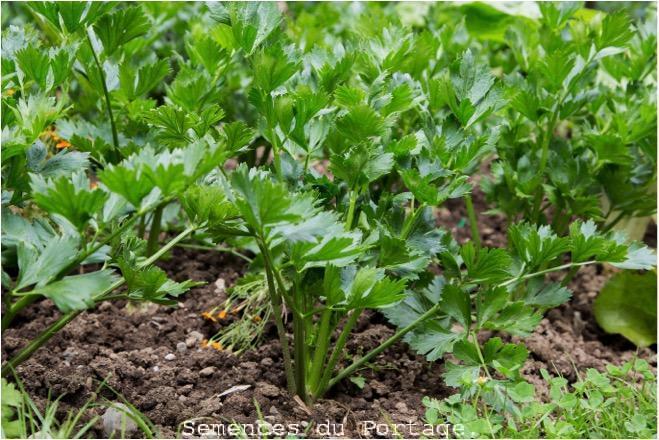
About Tango celery
Tango celery is a classic cultivar that develops crisp, fleshy stalks. It is low in fiber and early maturing. It germinates slowly.
Growing tips for Tango celery
Gardening articles related to Tango celery
Our tango celery seeds are certified organic.
We use natural, eco-friendly methods to grow our plants, without pesticides, herbicides, or chemical fertilizers. By choosing our organic tango celery seeds, you support a responsible, nature-friendly approach.
Learn more:
Yves Gagnon
Celery growing conditions
Celery is native to humid environments. It therefore requires a high and constant humidity level. In addition, because of its maritime origin, celery is adapted to regular and stable climatic conditions; in irregular conditions, it loses its quality and goes to seed prematurely. Celery requires full sunlight. It is preferably grown in organic, deep and fresh soil. However, good results can be obtained in mineral soil, provided that it is generously amended with mature compost and that irrigation maintains a high humidity level. Since celery is a plant requiring mature compost, mineral soil should be amended with 2 t of mature compost per 100 m2. If a boron deficiency is detected either by analysis or by observing brown stems, a deficiency symptom, 100 g of borax should be added to the soil per 100 m2. Seaweed flour can also be added at a rate of 1 to 2 kg/100 m2. A pH between 5.5 and 7.5 is suitable.
Celery Crop Rotation
Celery is grown in the second year of rotation, with other leafy vegetables, after growing plants that require young compost.
Celery Companionship
Due to its high water requirements, celery cannot be mixed with many other species. A combination with celeriac and bulb fennel provides suitable conditions for these three species, which love organic matter and moisture. It can also be mixed with brassicas, leeks, or other leafy vegetables.
Interview
Celery should be irrigated before the soil dries out. Weeds are controlled by regular hoeing. A plant mulch can also be applied between the rows to control competition and limit
evaporation. Mulch helps blanch celery plants. To blanch celery, hill up the plants
15 days before harvest.
— These valuable tips were written by Yves Gagnon, in the book The ecological cultivation of vegetable plants , Colloidal Editions.
