


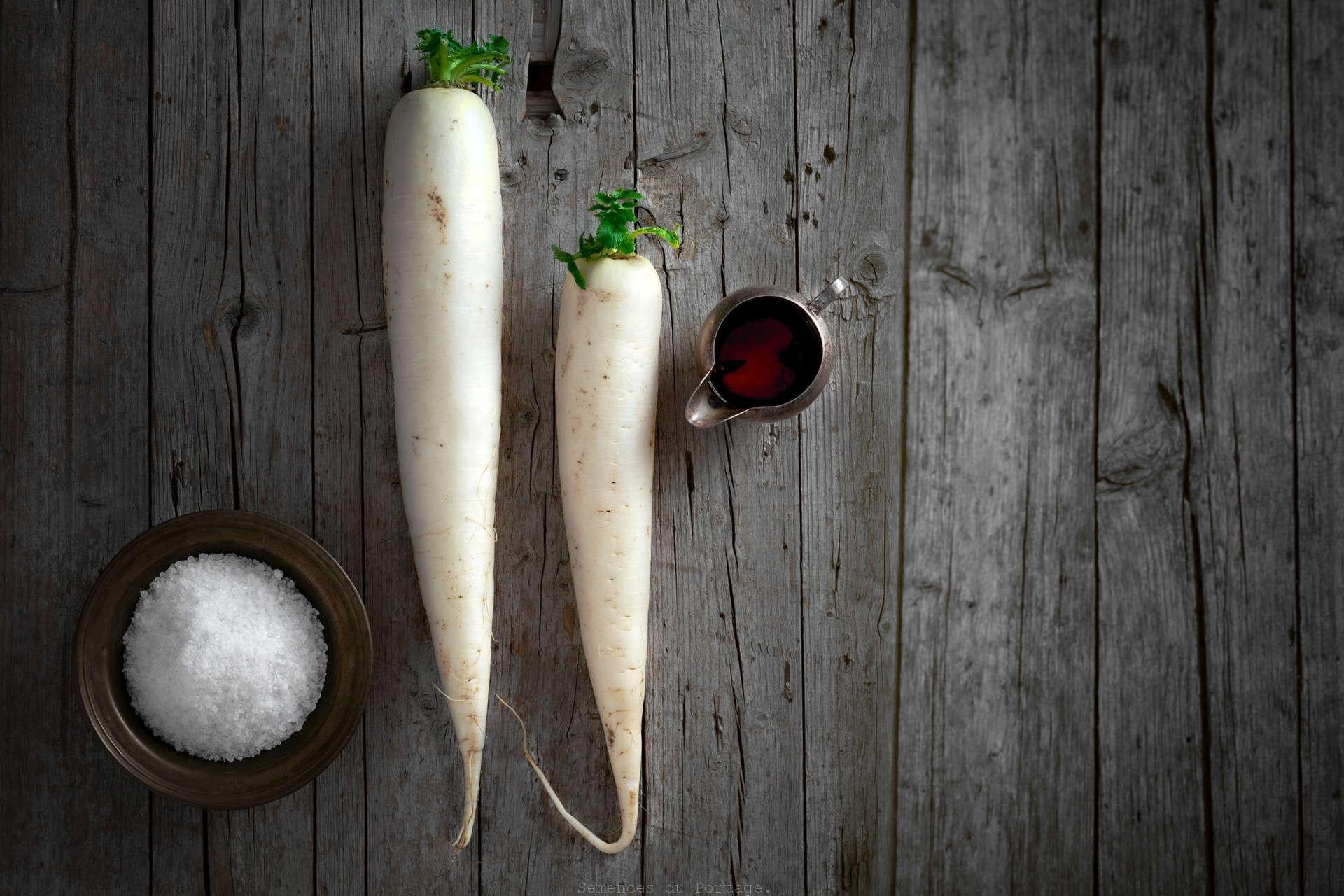
About Daikon radish
Of Asian origin, the Daikon radish produces a long, white, crisp, and spicy root that can reach 25 cm in length . For spring or late summer cultivation. Keeps well.
Growing tips for Daikon radish
Gardening articles related to Daikon radish
Our daikon radish seeds are certified organic.
We use natural, eco-friendly methods to grow our plants, without pesticides, herbicides, or chemical fertilizers. By choosing our organic daikon radish seeds, you support a responsible, nature-friendly approach.
Learn more:
Daikon radish
Daikon radish, generally white, long, and cylindrical, can reach 50 cm in length and 5 cm in diameter. It is mainly grown in late summer for an autumn harvest. It can be stored for several months in a cold room.
Yves Gagnon
Growing conditions for radishes
Radishes reach their best quality in cool weather. They are frost-resistant. Warm, dry conditions induce flowering and contribute to the development of a pungent flavor and fibrous texture. They are therefore best grown in spring or autumn. Some cultivars are adapted to a particular season. Since the small common radish appreciates an increasing photoperiod, it is mainly grown in spring. Black and Oriental radishes respond better to autumn conditions. All radishes prefer cool, loose soils rich in organic matter. To achieve maximum quality, they must be provided with consistent moisture. They tolerate overhead irrigation as long as it is not in broad daylight. The soil for their cultivation is amended with 500 kg of mature compost per 100 m2. The soil must be well supplied with boron, manganese, and copper. A pH between 5.5 and 6.8 is suitable for them.
Radish Crop Rotation
Radishes are often grown in the second year of rotation with plants that require mature compost. Because of their very short growing time, they can also be grown alongside frugal plants at the end of the rotation. Fertilization will then need to be adjusted.
Companion planting of radishes
Radishes can be grown alongside leafy vegetables that require mature compost, as well as carrots, beets, parsnips, and swedes. However, as the species is vulnerable to cabbage maggots, it is often grown under agrotextile in spring alongside turnips and early cabbages, and in autumn alongside Chinese cabbages, which should also be protected from the pest with a floating tarpaulin.
— These valuable tips were written by Yves Gagnon, in the book The ecological cultivation of vegetable plants , Colloidal Editions.
