


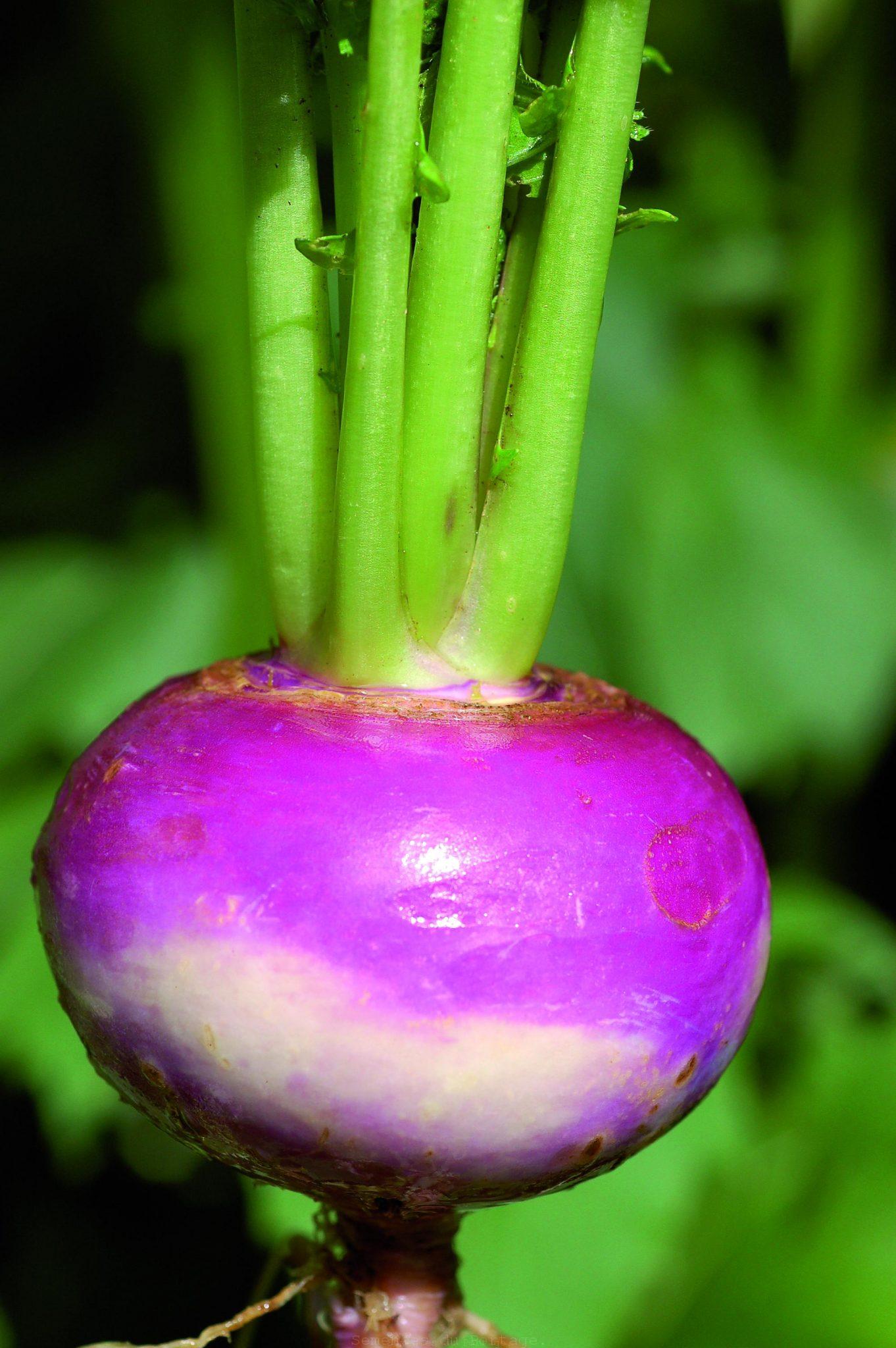
About White Turnip with Purple Collar
The white turnip with a purple collar, also called rabiole, is early and produces white flesh and a purple collar. Delicate taste in cool conditions and when harvested young.
Growing tips for the White Turnip with Purple Neck
Our white turnip with purple neck seeds are certified organic.
We use natural, eco-friendly methods to grow our plants, without pesticides, herbicides, or chemical fertilizers. By choosing our organic white turnip with purple neck seeds, you support a responsible, nature-friendly approach.
Learn more:
Yves Gagnon
Turnip growing conditions
Turnips are a cool, humid climate plant that grows in full sun. They are sown early in spring or for an autumn harvest. Heat and drought encourage the development of fibrous, bitter roots. Turnips are best grown in light, fresh, humus-rich soils. Clay soils are suitable as long as they are well-structured. Turnips are not very demanding. They can be grown without any compost as long as the soil has been well-amended the previous year. In poor soils, a small amount of mature compost can be added. The soil must be well-supplied with boron. In case of boron deficiency, 100 g of borax per 100 m2 should be added. Constant humidity ensures good taste. The ideal pH for growing turnips is between 5.5 and 6.8.
Turnip Crop Rotation
Since turnips are not very demanding, they are normally grown in the last year of the rotation with other frugal plants, after growing demanding plants. However, because of their sensitivity to cabbage maggots, they are often found in the second year of the rotation in association with other brassicas, which must be grown under a floating cover. Fertilization will then need to be adjusted to their needs.
Companionship of the turnip
Turnips can be grown with most frugal plants, including carrots, kohlrabi, and beets. However, because of the protection it needs against cabbage maggots, it is often grown with other crops grown under agrotextile, such as radishes, broccoli, and early cabbage in the spring, or Chinese cabbage and radishes in the fall.
— These valuable tips were written by Yves Gagnon, in the book The ecological cultivation of vegetable plants , Colloidal Editions.
