The onion... A venerable bulb
Since moving to Saint-Didace in 1980, I have had a boundless reverence for the onion, a lily that occupies a prominent place in my diet and helps strengthen my resistance to infections, especially colds and flu. I eat it raw and cooked at an average of one onion per day. I produce 400 bulbs per year, 50 of which are used for seed production.
A natural antibiotic
The onion— Allium cepa —is recognized for its significant medicinal properties. A member of the lily family, it is considered a natural antibiotic like garlic thanks to its sulfur-based components. Consumed raw and cooked regularly, it prevents the onset of flu and colds. In addition to its anti-infectious properties, the onion has diuretic, digestive, and tonic properties. It is beneficial for the liver and pancreas. It improves cardiovascular health by thinning the blood, reducing hypertension, and preventing clots. It is well-sourced in potassium and calcium, and contains phosphorus, magnesium, sulfur, silica, zinc, selenium, iodine, iron, fluoride, bromine, and barium. It contains vitamins A, B1, B2, B5, C, and E. Since it keeps well in a cool, dry place, a pantry or cupboard can store all the onions you need for the winter. Onions are used in the preparation of a majority of recipes: soups, stews, sauces, salads, terrines, etc.
Cultivation method
For onions to deliver all their benefits, they must be organic. Industrial onions are grown in vast monocultures with heavy use of chemical fertilizers, herbicides, insecticides, and fungicides. However, the lily can be produced without the use of all these poisons. Onions prefer light, well-drained soil, enriched with mature compost. They produce generously when grown following a heavy crop, with copious amendments.
To produce good quality onions, it is better to transplant seedlings rather than sowing onion sets, which often produce onions with a pungent taste.
Indoor sowing
To produce onion plants, sow 80 seeds per standard tray in a lightweight potting mix made from 40% well-ripened vegetable compost, 30% perlite, and 30% coconut fiber. These last two can be replaced with organic seedling potting mix. Young seedlings require high light requirements, as their narrow, pointed leaves offer little surface area to capture light photons. Sixteen hours of the correct light spectrum are therefore required for optimal quality. In the presence of natural light, Cool White fluorescents placed a few centimeters above the tops of the plants are suitable. As the species is susceptible to damping-off, overwatering should be avoided: the surface of the potting mix should be allowed to dry out between waterings.
If the green of the plants is not strong or if their growth is stagnant, you can fertilize the plants with a solution of soluble seaweed and fish emulsion at a rate of 10 ml each per liter of irrigation water. While they are in the boxes, cut the plants back with scissors by 18 to 15 cm as many times as necessary. Do not transplant the onion plants. Using a fan directed at the plants helps strengthen the stems. I have noticed that the seedlings do better once transferred to my small greenhouse where the night temperatures of 10 °C give tone to the stems.
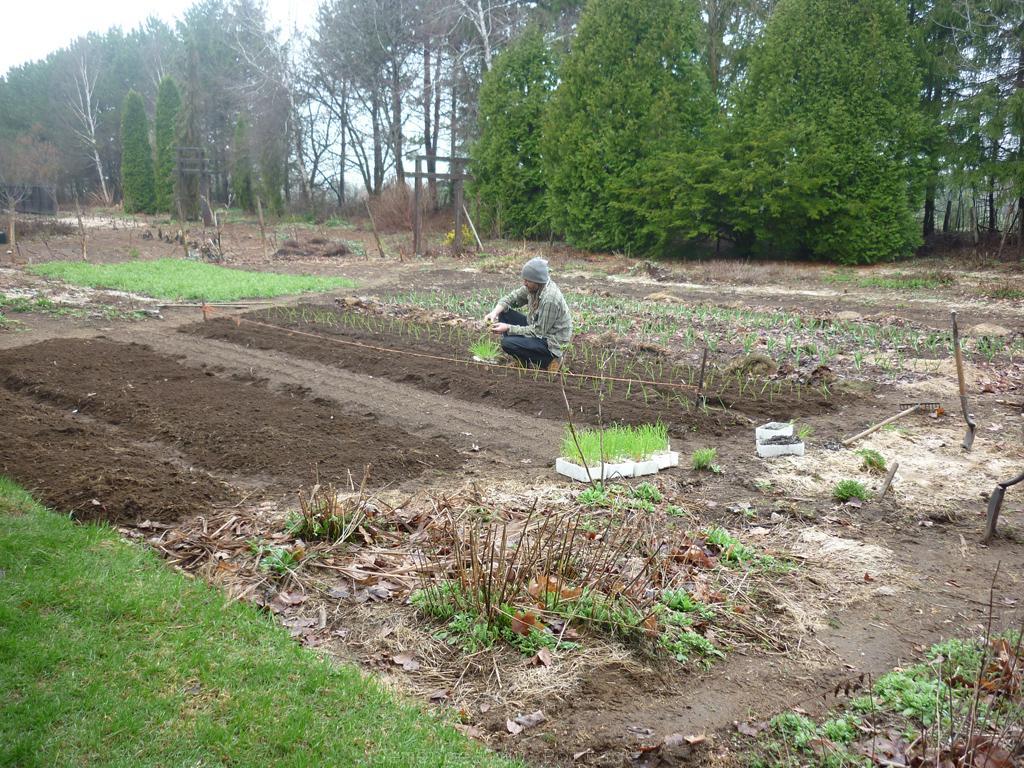
The establishment in the garden
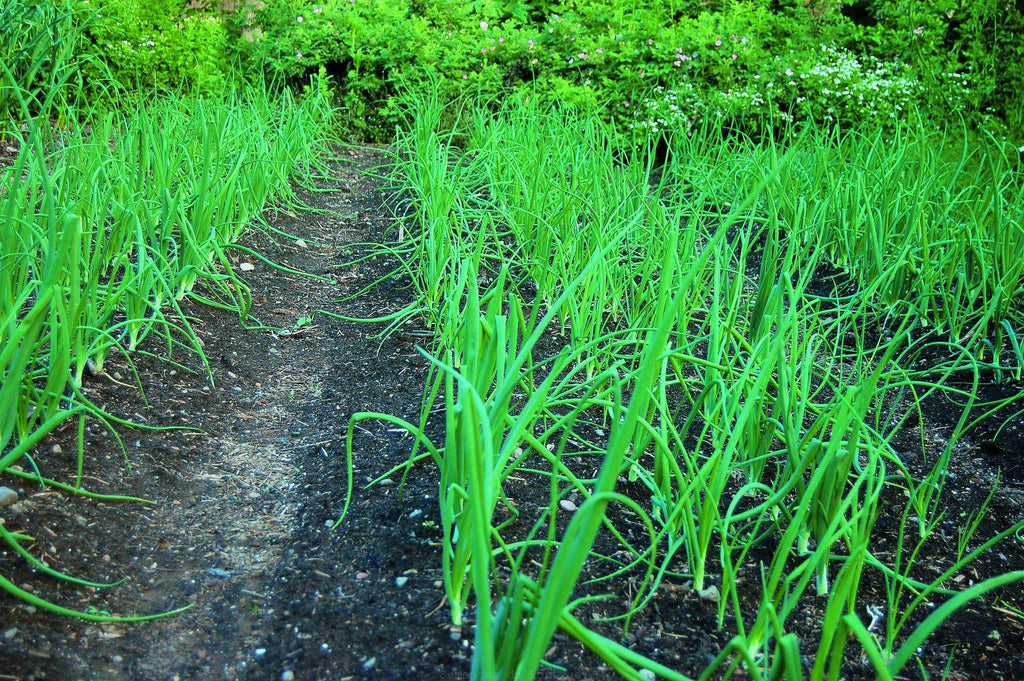
Onions are transplanted into the garden in late April or early May in rows 25 cm apart to every 15 cm in the row. Avoid overly close companion planting with other vegetables, as onions are susceptible to fungal diseases and require good air circulation. A few hoeings every two weeks are necessary to control competition. In cases of spring drought, sprinkler irrigation can be used. Afterward, onions appreciate dry conditions, which contribute to their phytosanitary quality.
Onions are harvested 8 to 10 days after the stem has fallen, usually in late August. They are then spread out in a dry, well-ventilated place to allow the bulbs to fully ripen. The stems are trimmed slightly above the collar. The bulbs are stored in woven nylon bags in a cool, dry place.
Occasionally, during the winter, we empty the pockets to identify the softened or sprouted plants so we can eat them first. This is an excellent opportunity to prepare a fortifying onion soup. It's all in the genetics. Although management is important for onion cultivation, it is the genetics of the chosen cultivars that determine their taste quality as well as their behavior in the garden. In the kitchen, we like to have one cultivar available for cooking and another for eating raw, in salads or sandwiches.
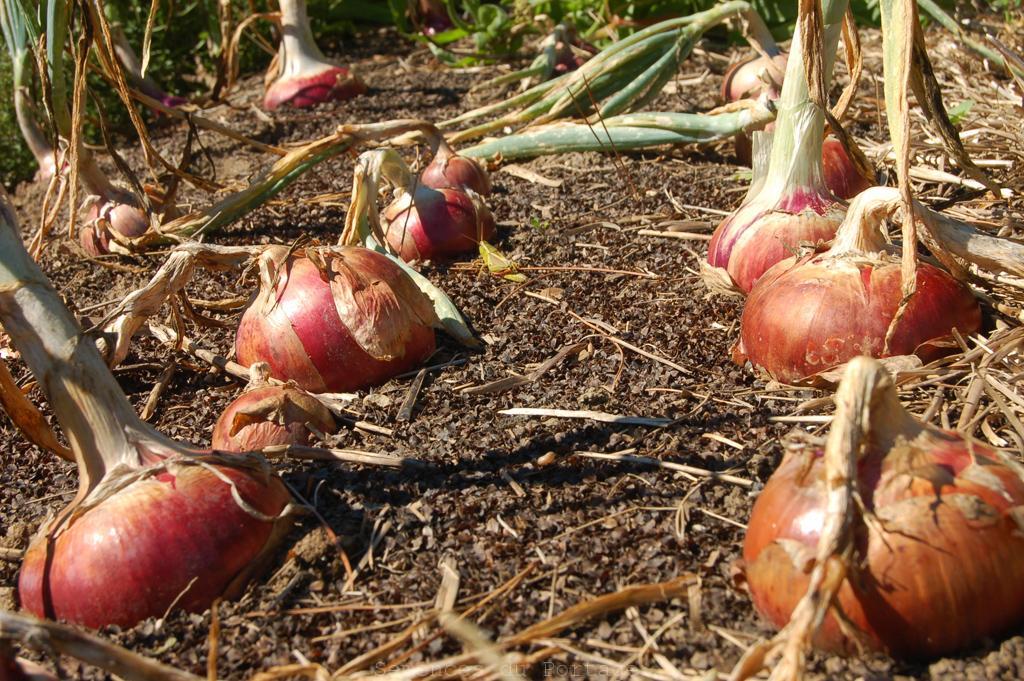 The Saint-Didace Red Onion a few days before harvest.
When I arrived in Saint-Didace, I produced tons of onions from onion sets. Disappointed by their quality, I decided to focus on producing plants. We experimented with the yellow table onions Early Yellow Globe, New York Early , Prince, Copra and Cortland, the red onions Red Man, Mars and Red Florence, as well as the sweet onions Ailsa Craig and Sweet Spanish Utah. After many years of experimentation, we settled on the Red Man onion. This beautiful red onion is very versatile, as it can be eaten cooked and raw and, what's more, it keeps until April. For nearly 30 years, we have been producing the seed, which has allowed us to improve, through selection, the quality and behavior of the cultivar, now well adapted to our conditions. By systematically eliminating diseased, soft or sprouted onions from our personal stock, we were able to multiply the cultivar with healthy mother bulbs and develop a storage line that is more resistant to disease. Proud of our work improving this cultivar through selection over all these years, we decided to name it Rouge de Saint-Didace .

Since the onion is a biennial species, we must plant the previous year's bulbs early in the spring. Each spring, we plant 100 selected bulbs at a depth of 10 cm, spaced 30 cm apart. These produce magnificent umbels composed of hundreds of white flowers in the summer. Once fertilized, they develop capsules that we harvest once they have turned brown and are slightly open. The presence of honeybees is essential for the fertilization of onion flowers. The inflorescences are left to dry for a month on trays. We then detach the capsules from the stems and rub them to release the seeds. All this material—seeds and flower debris—is transferred to a bucket of water; the good seeds settle to the bottom while the empty seeds, husks, and stems float; these are removed using a sieve, then the good seeds are collected and left to dry.
Onion seeds can be stored for two years.
Dealing with diseases and pests
In accordance with the principles of companion planting, we initially grew our onions with carrots. This association had the advantage of reducing the presence of the carrot fly. However, a year of heavy rains led to the appearance of the fungus Peronospora destructor, responsible for onion blight. This fungal disease is first characterized by the appearance of purplish down on the foliage; then, pale green spots appear on the foliage which quickly yellow, brown and die back. The appearance of this infection can be prevented by growing onions without a companion in order to promote air circulation and by spraying a 10% milk solution every week from July 15.
Leaf blight is another fungal infection caused this time by the fungus Botrytis squamosas . The disease is characterized by small, round, pale leaf spots that turn brown and then dry out. Dieback begins at the tip of the leaf and spreads downward. The use of resistant cultivars, good air circulation, and sprays of horsetail or baking soda can reduce the severity of the infestation.
The onion fly— Delia antiqua —is not normally a problem when onions are transplanted early. However, the leek moth— Acrolepiopsis assectella —a moth recently arrived from Europe, sometimes causes significant damage to onions, although it is more commonly seen on garlic and leeks. The moth lays its eggs in June on the upper leaves. The small caterpillars that hatch from them feed on the leaves, which appear as whitish marks. They are crushed by hand or controlled by spraying BTK, a bacterial insecticide, before the larvae can penetrate the hollow leaf where they can continue their ravages, well protected.

Growing onions has always given me a sense of pride. In the middle of winter, when I make myself a comforting onion soup, I realize the extraordinary privilege of being self-sufficient in food.
Recipe
Onion Soup (8 servings) from the book The Daily Feast

Ingredients :
- 12 medium onions
- 2 leeks
- 2 celery stalks
- 2 cloves of garlic
- 30 ml (2 tbsp) vegetable oil
- 30 ml (2 tbsp) flour
- 3 liters (12 cups) of water, stock or broth
- 3 bay leaves
- 5 ml (1 tsp) thyme
- salt and pepper to taste
- 8 to 10 croutons
- grated cheese (Gruyère, Emmenthal, strong cheddar) for gratin
Preparation
Slice the onions, leeks, celery, and garlic and brown them with vegetable oil in a pot. Sprinkle with 30 ml (2 tbsp) of flour, stir, then add the liquid, bay leaf, and thyme and simmer for 75 minutes. Adjust the consistency by adding water or broth. Remove the bay leaves and season with salt and pepper to taste. Pour the soup into individual oven-safe bowls. Cover with a crouton and 30 to 60 ml (2 to 4 tbsp) of grated cheese. Bake at 200 °C (400 °F) until the cheese is golden brown. Serve steaming hot.
Variants
You can deglaze the browned vegetables with 250 ml (1 cup) of white wine before adding the broth. Adding 500 ml (2 cups) of tomatoes gives the soup an Italian touch; a few cubes of basil pesto are also a good idea. You can also cream the soup by adding 250 ml (1 cup) of cream. Finally, if you used water or clear broth, you can add 5 ml (1 tsp) of miso to each bowl, carefully mixing it with 15 ml (1 tbsp) of broth or water.
Text by Yves Gagnon Author and seed producer